The Truth Versus the Darkness
When the genius of equity-driven innovation collides with catastrophic current events, equities always win. Always.
November 2023
Somewhere in this great Republic of ours, a middle school child got on her school bus this morning. In her backpack was a brand new iPhone 15. Maybe she got it for her October birthday. It doesn't matter: she now owns it. We will find it useful to examine what exactly it is, and can do.
Simply stated, the young lady is carrying an instrument that commands more computing power than did all the IBM mainframe computers in operation on the planet in the year 1970.
But wait; there's more. If, when she gets to school, she is assigned to write a research paper about any subject in the world—nuclear physics, penguins, the Louisiana Purchase—this young person can use her iPhone to look up, at virtually no cost, all the public information on that subject in the entire world.
But wait; there's even more. Should the child find that a key research finding about her assigned topic was written in a language that she can't read, her iPhone—still for negligible cost—will translate it for her.
It isn't just that these capabilities were not anticipated or predicted by anyone in 1970. Merely to say that would be to miss the essential point here. Rather, we quite correctly observe that in 1970, an instrument whose capabilities I have just described was inconceivable.
But it is doubtful that even the most astute investors in the year 1970 were even thinking along these lines. Instead, their attention was more probably riveted on the unrelieved political, geopolitical, environmental, financial and economic horror that unfolded day after day throughout that melancholy year. Consider:
The first five months of 1970 saw the cataclysmic terminal phase of a bear market in stocks that had begun all the way back in the presidential election month of November 1968—itself an annus horribilis during which Senator Robert F. Kennedy and Dr. Martin Luther King Jr. were murdered, and the sitting president was driven from office.
That bear market, stretching over 18 months, drove the S&P 500 Index down a total of 36%. This was at the time by far the largest decline since the 1930s. It's not too much to say that an entire generation of investors—bred on the great bull market of the 1950s and ‘60s—had no longer believed that such a deep, prolonged market decline was even possible.
Only a couple of weeks after announcing that over 100,000 American troops were being withdrawn from Vietnam, President Nixon on April 30 went on national television—the YouTube video of his talk is readily accessible—and announced to a stunned nation that the United States had invaded Cambodia. The administration had not told the Cambodians, our South Vietnamese allies nor the U.S. Congress that it was going to do this until the incursion was under way.
Virtually every American college campus erupted in a firestorm of rage. At Kent State University in Ohio, young National Guardsmen with little training fired on the student demonstrators, killing four of them. Suddenly, after living in mounting hope that the nightmare of Vietnam was finally in the process of ending, our country was torn apart all over again.
Nineteen seventy was also a year of apocalyptic environmental pessimism. The world was popularly held to be running entirely out of resources even as global population exploded. The author of a huge bestselling book titled The Population Bomb appeared on Johnny Carson's Tonight Show upwards of two dozen times, cheerfully predicting that hundreds of millions of people would starve to death over the coming decade.
Finally—and to investors more ominous than all the other catastrophes put together—as 1970 progressed, it became increasingly evident that the very foundation of the West's financial system was about to collapse.
The Bretton Woods agreement of 1944 had created a postwar financial construct in which the world's currencies were effectively pegged to the U.S. dollar. That entire system rested on our commitment to buy and sell gold at $35 an ounce. But the cancer of inflation—which had begun in 1965 when President Johnson essentially tried to pay for the War on Poverty and the Vietnam War with the same money, hoping no one would notice—was by 1970 metastasizing apace. It became inevitable that we would eventually have to—in the jargon of the day—“close the gold window.”
By yearend, going off the gold standard was no longer an “if” but a “when.” In the event, the answer to “when” turned out to be August of the following year, but that fact is irrelevant to the point I'm making. Which is simply that in 1970 the financial equivalent of the law of gravity was about to be repealed, and no one could even imagine what chaos might follow.
We conclude from the foregoing that the year 1970 was at the very same moment the cusp of by far the most spectacular half century of technological innovation in mankind's history and an important milestone in the accelerating descent into darkness that would become the Somber Seventies.
Now, having absorbed all the wild and even existential contradictions of this astonishing year, we may proceed to examine—from a long-term investor's point of view—what actually ensued.
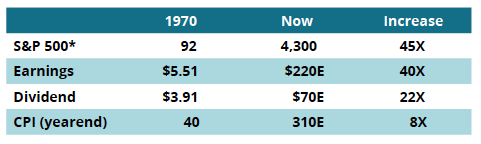
*Note that nine of today's ten most valuable companies in the Index by market capitalization did not yet exist in 1970.
What ought the long-term, goal-focused, plan-driven investor to infer from this? I propose two related conclusions:
- That, second only to love, human ingenuity is the most powerful force on earth.
- That equities are the only investment asset class that fully captures human ingenuity, rendering it into enduring wealth.
(I would most particularly draw your attention to the fact that the cash income produced by the S&P 500 has increased at nearly three times the rate of consumer inflation. If there is just one drop-dead critical statistic the retirement investor must know, this is surely it. In point of actual fact, the 10,000 people retiring in America every single day through at least 2029—when the youngest Baby Boomer turns 65—do not know it, and will not unless so informed by a Behavioral Investment Counselor. Spartans, this is why you and I were sent into the world.)
For perspective, I would add only that, in the 53 years since the end of 1970, the S&P 500 (including intraday panic bottoms) has declined at least 20% on 12 separate occasions. The three largest of these declines were 48%, 49% and 57%. Yet here we are, 45 times higher, not counting the reinvestment of dividends.
Ten thousand dollars invested in the Index at the end of 1970 and left to compound—taxes paid from another source—is as I write well in excess of $2 million, and the compound annual growth rate has been 10.7%. Along the way, the longest it has taken an Index investor to break even with reinvested dividends is five years and eight months. Without a scintilla of statistical demonstration to back me up, I would again confidently put the number of 53-year-old American couples who know any of this at plus or minus zero.
Which brings us up, quite literally, to today. And today, as then, we find the Great Companies' brilliant long-term stewardship of capital set against a manifestly darkening trend of current events. Jamie Dimon is surely right, as indeed he most often is, when he says, “This may be the most dangerous time the world has seen in decades.” To see this, all we need do is to enumerate the developments that have unfolded over the last five years.
- The Pax Americana that prevailed for 30 years following the collapse of the Soviet Union has ceased to function. The two major countries that were supposed to be liberalizing their governance as well as their economies have instead opted out of what President Obama fancifully termed “the international community.” China and Russia—both experiencing rapid demographic collapse—have returned to their isolated, authoritarian, bellicose ways, with Russia and the West in a proxy war in Ukraine, and China threatening not just Taiwan but all its neighbors in the region, and ultimately us. Xi and Putin skipped the most recent G-20 meeting in India.
- The Middle East has once again degenerated into genocidal conflict, as Iran edges steadily closer to nuclear capability. Afghanistan is returning to the darkness, after an ignominious bugout by the United States.
- Here at home, the administration is waging a war of extinction against our incredibly vibrant and productive oil and gas industry, even as it draws down its strategic petroleum reserve to a matter of a few days. America's energy independence, not to mention its opportunity to become Europe's go-to energy source (to Putin's great cost), is under relentless attack by our own government.
- Our southern border has ceased to exist. Millions of migrants are entering the country illegally, devastating local economies and creating an increasingly intolerable burden in the more progressive large cities. As well in those cities, crime, drug addiction and homelessness have reached unprecedented levels.
- The federal debt and deficit are increasing at unsustainable rates; a savagely divided Congress has demonstrated not just the inability but the complete unwillingness to address this.
- The fastest, sharpest interest rate spike in the 110-year history of the Federal Reserve has continued to increase the odds of a “hard landing” recession.
- The pandemic wreaked havoc on the K-12 public education system—most critically in the cities—and cratering ACT scores testify to its virtual collapse.
- Both Medicare and Social Security are on clear paths to insolvency.
- Inflation remains stubbornly high, especially in the service sector, sapping the incomes of America's middle class. The affordability of the single family home is at a low ebb. Higher education, far from preparing students for productive working lives, is in thrall to various tribal ideologies.
- We are now 12 months away from a presidential election of the most extreme potential divisiveness. Were the election to be held today, the major party candidates would almost certainly be the two most bitterly loathed men in public life.
- And finally, in 2025, America faces The Mother of All Fiscal Cliffs.
This jeremiad might well suggest to the prudent investor that he place his wealth in a diversified portfolio of long-term survival food kits, a solar generator, gold coins and shotgun shells—as current events/trends prompted more than a few people to do back in 1970. Remember, the armchair catastrophist in that year was anticipating that the dollar would momentarily become toilet tissue, and that hordes of starving people would soon break into his home to raid his Amana side-by-side refrigerator/freezer. One hopes you take this as a gently droll way of saying: we've been here before.
This time may be different in the details, but in fact it's never all that different. That's why Harry Truman said, “The only thing new in the world is the history you don't know.” And why the documentary filmmaker Ken Burns wonderfully said, “History is medicine. It has nothing to do with the past. It has everything to do with the present.” (Emphasis mine.)
That the financial world has appeared to be ending an even dozen times in the life of today's 53-year-olds and yet has signally failed to end—instead driving the broad U.S. stock market up 45 times—should carry some very significant historical weight in your clients' thought process.
Unless, of course, it doesn't.
In which case we may fall back on the other (and even greater) engine of long-term equity investing optimism: logic. Specifically, the simple logic that is the organizing principle of all rationally managed, profit seeking businesses—most particularly, the 500 largest, most profitable, most soundly financed and most innovative companies headquartered in America.
Note that becoming a long-term owner of these kinds of companies in pursuit of one's most cherished financial goals has nothing whatever to do with “investing in the stock market.” The differences, which are legion, are also immense. And they are critical to the analysis we're conducting here.
You see, any permutation of the headwinds listed above may at any moment cause “the stock market” to decline—sometimes significantly, but always temporarily. The investor has no way of knowing which crises will cause “the stock market” to decline, nor how deeply, nor for how long. As the crises ebb—soon to be replaced by still other crises—the investor has no way of knowing when “the stock market” will turn, and resume the quite spectacular advance it has been tracing out for our clients' entire lives, and much longer.
To state this phenomenally liberating truth even more succinctly, we say—as often as possible, to anyone who may listen:
The economy can never be consistently forecast, nor the market consistently timed.
I repeat that the adjective that best describes the state of mind of an investor who accepts these twinned truths is—or certainly ought to be—liberated. Knowing these truths, he never has to look at current events, nor worry about when to get out of, and back into, the market on account of them. Because he sees that gets him nowhere—indeed that it can't be done profitably.
Rather, the long-term, goal-focused, plan-driven equity investor—embracing the joys of unknowing—can cheerfully turn his attention back to working his long-term plan. He may do so with full confidence that whatever today's macroeconomic/geopolitical/financial woes may be, he has the best managers in the country working to preserve his permanent capital, and to find further profit opportunities in any adversity. For that is the incontrovertible logic of owning the Great Companies as one's core investment policy.
Assuming merely for illustration that all I own is the S&P 500 Index, all the companies in my portfolio are characterized by one glorious attribute: no power on earth can force them to continue losing money. Rational managements, whose duty to the shareholders is fiduciary, will simply stop—as hard and fast as they humanly can—whatever activity is producing losses.
Companies offering homeowners insurance in California, confronted with legislation effectively preventing them from making a profit, will stop writing it. Whole Foods, Walmart and other retailers, faced with massive theft which the electorate evinces no interest in preventing, will close their money-losing center city stores. Marriott, the largest hotelier in the world by number of rooms, simply shuttered its hotels and furloughed their staffs during the pandemic's global lockdown. One can think of numberless other examples. The most fundamental imperative of a rationally managed business will always be to protect, to the greatest extent possible, the permanent capital of the owners.
But it is not merely their fierce husbanding of shareholder capital in adversity—vitally important though it be—that is the greatest benefit of owning the Great Companies. In the long run, the very best defense of capital is to grow it. And as we have seen, companies' immensely successful commitment to technological innovation—from Intel's first microprocessor in 1971 to Apple's iPhone 15 this year, and everything in between—is the ultimate source of their power to create wealth.
And there are manifold other ways by which companies enhance their owners' wealth. Just this past month, we mainstream equity investors got to experience one of those methods, to potentially great effect. I refer, of course, to two of our companies—Exxon and Pioneer Natural Gas—combining in such an opportunistic way as may benefit us owners richly over the next several years.
The combined company will be capable of sharply increased Permian Basin production, while capturing very significant economies of scale—and in the process lowering the price at which its production becomes profitable. Perhaps most important, we passive investors didn't have to do anything in order to effect all this. We had a genuinely great executive (Exxon CEO Darren Woods) working the problem for us—and he really came through.
If I hadn't already suggested this, and/or if it isn't intuitive, my family and I employ Mr. Woods, as do all the other owners of the company. So as much as I may be temperamentally disposed to vexation about the current administration's war on hydrocarbon energy—and heaven knows I am—I could rest relatively easier knowing that I had Mr. Woods defending our capital and seeking ways to increase its return.
We also employ such individuals as the aforementioned Jamie Dimon at JP Morgan Chase, who is working that particular set of financial issues for us. (We also bank there.) Tim Cook has been busily multiplying our equity in technology for some years now. Warren Buffett—less our employee than our partner—is allocating his and our capital side by side, more brilliantly perhaps than anyone who's ever lived.
Vicki Hollub at Occidental is another masterful executive in the oil patch for us. (Buffett enthusiastically concurs.) Jane Fraser is cleaning up Citicorp on our behalf, taking out whole layers of management. A seasoned executive we'd not previously heard of called Tim Wentworth came in last week as the new CEO of Walgreens, with the immediate mission of taking a billion dollars out of our company's cost structure. I can go on and on like this, and would enjoy doing so, but I think you get the point.
What on earth do you suppose “the stock market” has to do with all this? I'm sure I have no idea. More to the point, I assure you that you don't either, nor does anyone else. Once more with feeling: the economy can never be consistently forecast, nor the market consistently timed. There is no repeat no method of correlating current events to “the stock market.”
I know that the S&P has declined peak to trough an average of 14% annually for several decades, that it has gone down (if only intraday) at least 20% on 16 separate occasions starting in 1950, or once about every four and a half years, and that the average of those episodes was a temporary decline of about a third.
I see no reason to think it will stop doing that, and I regard the act of riding those declines out—merrily compounding our steadily increasing dividends at panic share prices—as the one true price of totally effortless wealth. I repeat that over these nearly eight decades the longest it could have taken anyone to break even in the S&P 500 (dividends reinvested) was five years and eight months. My family and I did not think that was too long to wait. We've found over time that the prices of the stocks on any given day may bear no relation to the enduring (and increasing) values of the companies.
Be assured that I don't idealize large corporations; I'm a rational optimist, not a Pollyanna. They can become bureaucratic, political, and either excessively risk-averse—missing opportunities other companies seize—or recklessly chasing synergies that prove illusory. Occasionally, they engage in fraud (Enron). In other instances, sheer stupidity and/or greed are permitted to override prudent risk management (Bear Stearns, Silicon Valley Bank). Companies are, after all, human institutions, capable of exhibiting all too human foibles. An efficient market inevitably weeds out the companies that deserve to fail, and our policy of broad diversification largely if not quite perfectly erases those failures.
That aside, to me the highest function of the wealth manager is to get (and keep) his/her clients focused on the powerful logic of rational companies, and on the history of that logic consistently manifesting as effortless wealth for the long-term investor.
Otherwise, your professional life degenerates into people constantly calling you, asking you if the government is going to shut down—or whatever the crisis du jour is—and shouldn't we get out of the market. No reader of this newsletter should ever have to live that way.
The canoe of mainstream equities doesn't capsize. An investor may very well be killed—and many are—jumping out of the canoe in order to escape the perceived danger of it capsizing. He'll be dashed against the rocks of some violent rapids, or drowned leaping out of the canoe as it goes over a roaring waterfall. Yet the canoe does not capsize. There are even those of us who believe that it can't.