
Sample Issue 2026 Some Further Thoughts on "The Mythology of Bonds"
You'll note that this month's Client's Corner focuses on the five years ending this December, which may end up being the worst such period for stock vs. bonds in at least 50 years. I freely acknowledge twice in that piece that I've chosen this period knowing that it's something of an outlier.
Yet to me, it's a wonderfully vivid and readily comprehensible demonstration of my work's essential thesis, to wit: In real life, bonds are destructive of clients' purchasing power over time, while equities are peerlessly accretive to it. And—again in real life—purchasing power is the single most important of all financial elements. Indeed, it's the only rational definition of money.
Like all Client's Corner essays, this one is meant to be a conversation starter. I question how many of your clients are likely to realize without any prompting that when these five years are over, the cost of living will have risen 25%. And it will not go back down.
Inflation may accelerate or slow, and financial journalism will produce millions of words every month on the rate at which it's changing. But for someone facing down a two-person three-decade retirement, the rate of change is almost an abstraction. There's a much larger, even definitive truth about inflation, and for some reason it isn't obvious. It's that prices never go down. Let me say that again, because it's the heart of the conversation I'm urging you to start here: The cost of living never goes down. It only goes up, at some greater or lesser rate.
Another way of saying that the CPI will have risen 25% in these five years is, of course, that a dollar of fixed income will now buy only three quarters of what it did a mere five years ago. Heaven knows people are painfully aware of inflation as a generalized phenomenon—most sharply experienced in the cost of food. Indeed this issue was contributory to, if not decisive of, the outcome of the most recent presidential election. Still, one wonders if they're taking full account of it as investors.
That equity dividends rose over these five years at a significant premium to inflation—that they accreted retirees' purchasing power, because that's the very essence of what dividends do—is sadly not intuitive even to reasonably intelligent investors. We have to draw a line under it for people.
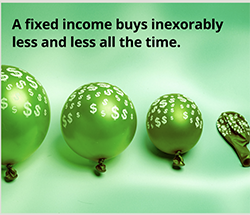
But that can only come with full force after we bring the investor face to face with the fact that a fixed income buys inexorably less and less all the time. Such that in long retirements it can actually impoverish people—even as they pursue the toxic illusion of “keeping our money safe.”
With the whole world freaking out over stretched valuations and the overconcentration of the Index in the Mag 7, I can't imagine a better time to be quietly refocusing clients on the power of dividends in general, and on dividend growth in particular. Since at least 1960, dividends have been growing at a rate very close to twice the CPI—just under six percent for dividends vs. just over three percent for inflation. People simply do not know this. If they did—if they took the full implication of it on board—your long-term stocks versus bonds conversations might get a whole lot healthier in a hurry.